
Bal Gopal Krishna Murti (5 inch) – Standing Bal Krishna Idol with Mor Pankh for Home Mandir
Buy more, save more
About this murti
No flute. No butter. Just a small boy with a peacock feather in his hair, standing on a rock, entirely pleased with himself.
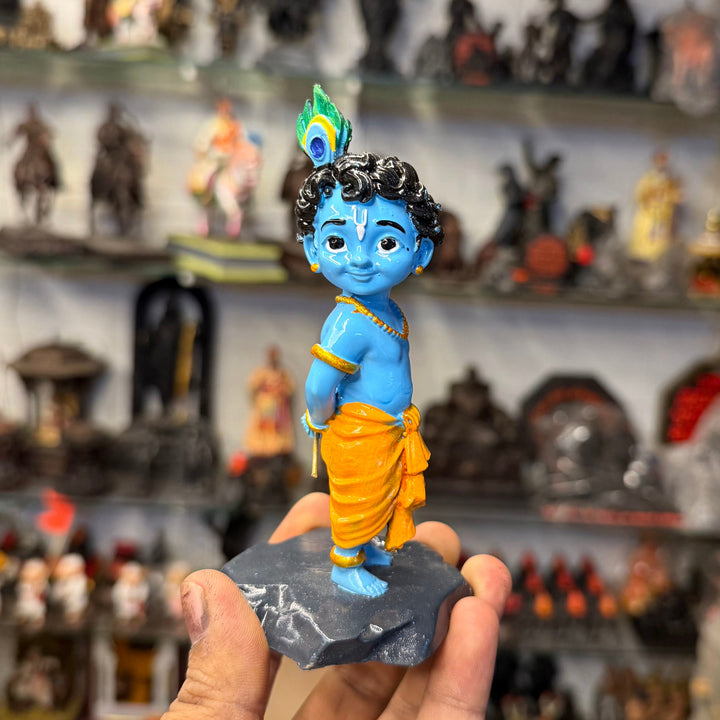
This is Bal Gopal before any of the stories start. A child in a saffron dhoti that someone has tied a little loosely, gold at his ears, neck, arm and ankles, and one mor pankh standing straight up out of his curls. The hands are empty. He is not doing anything. That is the whole appeal of him.
Most Krishna murtis are finished in antique metal. This one is in full colour, and that changes what it does in a room — on a mandir shelf among brass and silver, it is the piece your eye goes to first.
The piece
Blue body, saffron-orange dhoti with a pleated fall and a sash knotted at the side. The gold work runs through the earrings, the two-strand necklace, the armlet on the upper arm, the waistband with its hanging tassel, and the anklets on both feet.
The face carries a white urdhva pundra tilak on the forehead and a small smile. The curls are picked out one by one in black, and the mor pankh above them is painted in green, yellow and blue. He stands on an irregular grey stone base rather than a flat plinth, so the piece reads as a boy caught mid-step rather than posed.
- Bal Gopal standing, hands free, 5 inches tall including the base
- Full-colour finish — blue body, saffron dhoti, gold ornaments
- Mor pankh upright in the curls, painted green, yellow and blue
- Urdhva pundra tilak on the forehead
- Irregular grey stone base, roughly a small saucer in footprint
- Home mandir, pooja room, living room shelf, study or office desk
- Selected from artisan clusters across India
Questions people ask
Who is Bal Gopal?
Bal means child and Gopal means cowherd. Bal Gopal is Krishna as a boy in Gokul, before Vrindavan and long before Mathura or Kurukshetra. It is the form most commonly kept in Indian homes, because the child Krishna is approached with affection rather than awe.
Why is Krishna shown blue?
The name Krishna itself means dark. The old texts describe his complexion as the colour of a rain cloud or deep water, and over centuries painters and sculptors settled on blue as the way to show that. A blue Krishna is the traditional depiction, not a modern choice.
What does the peacock feather mean?
The mor pankh is Krishna's defining mark and he is shown wearing it from childhood onwards. The stories connect it to the peacocks of Vrindavan that danced when he played. In practice it is the single detail that lets anyone identify a Krishna murti at a glance.
Is this the same as Laddu Gopal?
No. Laddu Gopal is the crawling infant holding a laddu, usually dressed in cloth, placed in a jhula and cared for daily like a child of the house. This is a standing Bal Gopal with empty hands, kept as a murti rather than dressed and changed.
How big is 5 inches in practice?
About the height of a standard water glass, with the base taking roughly the footprint of a small saucer. It suits a mandir shelf, a study table or a console without crowding it, and it is tall enough to be seen from across a room.
Can Bal Gopal be kept for daily pooja?
Yes. The child form is among the most commonly kept in Indian homes. Traditional practice places the murti so the worshipper faces east or north while praying, and keeps it off the floor and out of the bedroom.
How is it cleaned?
Wipe with a dry, soft cloth. Keep it away from water, oil and direct heat, and out of long hours of direct sunlight, so the painted colour stays true.
A straightforward choice for Janmashtami, for a child's first murti at home, or for a mandir that already has plenty of metal in it and nothing in colour.
How we choose a murti
The face decides it. Most idols in the market come from a small number of moulds that have been copied and re-copied until the jawline softens and the eyes lose their definition. We list a murti only when its face still looks like someone you can recognise from across a room.
The base decides where it can live. Most of these murtis end up on a car dashboard rather than on a shelf, so we look for a base that is wide enough and flat enough to sit steady on a slope.
The finish has to survive a parked car. One afternoon behind glass in May is harder on a finish than years on a mandir shelf. If a murti looks tired after that, we do not list it.
We do not discount what we reject. If a murti is not good enough to send you, we do not sell it at a lower price instead. We simply do not sell it.
Size, weight and placement
| Material & weight | Size: 5 inch height, including the stone base Form: Bal Gopal standing, hands free Finish: Full colour — blue body, saffron dhoti, gold ornaments Detail: Mor pankh in the curls, urdhva pundra tilak, two-strand necklace, armlet, waistband with tassel, anklets on both feet Base: Irregular grey stone, roughly a small saucer in footprint Care: Wipe with a dry, soft cloth; keep away from water, oil, direct heat and long hours of direct sunlight |
|---|
On a car dashboard. The base matters more than the height. A wide, flat base stays steady on a sloping dashboard, while a narrow one shifts and topples the first time you brake hard. Check the height against your windscreen line before you choose a larger size.
Heat. A parked car in May becomes hot enough to soften a poor finish. The finishes we choose hold their colour, but a sunshade is still worth using on hot afternoons.
At home. Most mandir shelves are 8 to 12 inches deep, so measure the depth rather than the width. Height is rarely the constraint; depth almost always is.
Light. An antique finish looks best when the light falls from the front and slightly above. A diya at the base does this naturally, while a ceiling light directly overhead flattens the detail.
Delivery, cash on delivery and replacement
Dispatch. We dispatch six days a week. Most orders arrive in three to eight days, and the exact day depends on where the order is going.
Packing. Every murti is double-boxed and held in a foam cradle cut to its shape. This is the most expensive part of fulfilling an order, and it is the reason breakages are rare.
If it arrives damaged. Record a video while you open the parcel, starting before you cut the tape. Send us that video on WhatsApp and we will send a replacement. You will not have to argue with the courier, fill in a form, or pay anything to return the damaged murti. We cannot process a claim without the video.
What a replacement covers. Damage in transit. We are not able to take a murti back once it has reached you undamaged, so please check the size on this page before you order. If you are unsure, send us a photo of the space on WhatsApp and we will tell you which size fits.
Cash on delivery. Available anywhere in India. You pay ₹59 online to confirm the order and the balance at your door.
Care
Dust the murti with a dry, soft cloth. For the crown and the jewellery detail, a shaving brush reaches further than a duster.
Do not use soap, alcohol or metal polish. The antique layer is deliberately thin, and these solvents lift it.
Kumkum and oil marks come off with a slightly damp cloth if you clean them the same day.
Indoors, the colour holds indefinitely. On a dashboard, a sunshade on hot afternoons will keep it that way.
Most families order more than one
One murti for the car and one for the mandir at home. When they are ordered together, they ship in a single box.
The quantity discount is applied automatically at checkout.
Questions
Which size should I choose?
For a car dashboard, choose 3 to 4 inches. That is large enough to be seen clearly and small enough to stay out of your line of sight.
For a home mandir or a shelf, choose 6 inches or more, because a small murti looks lost in a large space. For an entrance or an office desk, 5 to 6 inches works well.
The size of this murti is listed above. If you are still unsure, send us a photograph of the space on WhatsApp and we will tell you which size fits best.
Is cash on delivery available?
Yes, anywhere in India. You pay ₹59 online to confirm the order and the balance to the delivery agent at your door.
If you pay the full amount by UPI instead, you save a further ₹99.
How long will delivery take?
Usually three to eight days. The exact day depends on where the order is going, and shipping is free on every order.
The dates shown above are an estimate rather than a guaranteed date.
What should I do if the murti arrives broken?
Please record a video while you open the parcel. Start recording before you cut the tape and continue until the murti is out of the box.
If it is damaged, send us that video on WhatsApp and we will send a replacement. You will not have to argue with the courier, fill in a form, or pay anything to return the damaged murti.
That video is the only proof we need, but we cannot process a claim without it.
Can I send a murti back if I change my mind?
A replacement covers damage in transit. Once a murti has reached you undamaged we are not able to take it back, so it is worth checking the size and the photographs on this page before you order.
If anything is unclear, ask us on WhatsApp first. We would far rather answer a question than have you receive something that does not fit the space.
Do I save anything by ordering more than one?
Yes. Buying three or more murtis saves you 5%, five or more saves 8%, and ten or more saves 10%. The discount is applied automatically at checkout, so there is no code to enter.
Most families order one murti for the car and one for the mandir at home.